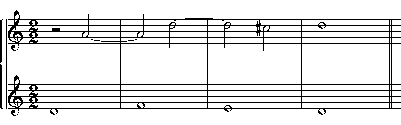
Fourth Species deals with syncopation. In duple meter one voice has two notes to each one of the other parts, and the second of each pair is tied forward. The second of each pair is the offbeat note, so each measure begins with a note held from before. The accented note that begins each measure can be either dissonant or consonant, but if dissonant it must resolve by step to a consonance. The second note of each measure must always be consonant. At the final cadence, however, or on rare occasions within the composition, you can revert to Second Species (we'll allow one such pre-cadence reversion for every 8 notes of the c.f.):
In a triple meter, the active voice will have three notes to each one of the other parts, and the third note of each group will be tied forward. In triple meter the second note of each group can be a dissonant passing or neighbor tone, though again the third note of each group must be consonant.
Fourth Species is all about practice in writing suspensions, one of the most effective contrapuntal devices you'll encounter. It seems we never tire of hearing well-crafted suspensions presented at important moments; they have an emotional impact. Doing these Second Species exercises will not only add to your general skill in note-handling but will also help you to quickly recognize an opportunity for a good suspension when one comes along. In these exercises it's particularly desireable to begin the fast voice with a rest. You will also be allowed occasionally to revert to Second Species by not tying a note over the barline.
 (As in first species) No voice should make a leap larger than a fifth, except for the octave and minor sixth.
(As in first species) Avoid making successive same-direction leaps in the same voice unless they outline a triad. If they can't be avoided they should at least total less than an octave.
(As in first species) Leaps greater than a fifth should be compensated by stepwise movement in the opposite direction.
(As in first species) No voice should move by a chromatic interval (any augmented or diminished interval).
(As in first species) Avoid repeating a pitch in the lowest voice. In upper parts you can repeat a pitch as many as three times successively if necessary.
(As in first species) Keep each voice confined to a singable range for the part, preferably not exceeding a 10th from its highest to its lowest pitch.
(As in second species) Avoid writing the same melodic interval twice on the same pitches.
(New) As in Second Species, one voice has two notes to each note of the cantus firmus, or in triple time it has three. The difference is that the last of each group is tied to the first of the next. If there are additional voices, they move with the cantus firmus as in first species.
(New) You may occasionally revert to Second Species if the situation demands it, simply by not tying the last note of the group over to the downbeat. But if you do, the downbeat note must be consonant as it is in Second Species.
(As in second species) The faster voice should begin after the cantus firmus, following a rest. The parts will still end together and can use the same note value for the final sonority. In three or more parts only one voice will be moving faster than the others; the others can still enter together.
(As in first species) Avoid writing parallel fifths or octaves (moving two voices in the same direction from one fifth or octave to another).
(As in third species) Avoid parallel fifths or octaves between the downbeat (accented) notes of two successive measures, unless the faster voice leaps by more than a third from the first perfect interval, or if the intervening note is consonant.
(As in first species) Avoid writing direct fifths or octaves (moving two voices in the same direction to a fifth or an octave). There are exceptions: these may be acceptable at a cadence, or if one voice is inner and the exposed voice moves stepwise. Direct 5ths in the outer voices will be accepted if the upper voice moves by step.
(As in first species) Do not let two voices leap to a perfect interval unless one of them is an inner part.
(As in first species) Avoid parallel fourths unless the lower tone of the fourth is not the bass and the pitch class a third below that note is present (that is, parallel 1st-inversion triads are OK). Fourths can also be allowed if one of the tones is nonessential.
(As in first species) One perfect interval can follow another in the same voices only if one of the voices moves stepwise.
(As in first species) Upper voices can sometimes cross if necessary, but avoid "overlapping" (in an overlap voices do not cross, but one moves to a position that is at or beyond the previous pitch of another voice). Overlap is allowed between upper voices in three or more parts.
(As in first species) Avoid writing more than three of the same interval in a row in any two parts (e.g. four consecutive thirds or four consecutive sixths).
(As in first species) In all species of counterpoint, use contrary motion frequently to emphasize the independence of voices.
(Modified from third species) The unison is acceptable on the second of a pair of accompaniment notes if it is preparing a properly resolved dissonance:
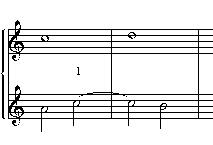
(New) The note tied forward must be consonant (the suspension is prepared by a consonance). Fux (see Alfred Mann, p.98) allows for an exception to this, saying that if the untied note is repeating a pitch then the preparation can be dissonant. Maybe this derives from Palestrina's use of the fourth as its own preparation (see C. H. Kitson, p.117) - that can only be accomplished if the longer tone is continuing the same pitch. For the present exercises we'll require a consonant preparation except for the fourth, which can serve as its own preparation if its bass is continuing.
(New) The downbeat note tied from before can now be either consonant or dissonant, but if dissonant it must be left by downward step. There can be no upward resolution of dissonance in Fourth Species.
(New) Accented dissonances (the only kind in Fourth Species) are best resolved to an inperfect consonance (a third or a sixth) but there are exceptions: the ninth can resolve to an octave, the second to a unison, and the fourth to a fifth.
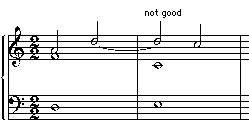
(New) At the moment of dissonance the pitch class of the resolution should not be already present somewhere else in the sonority. In the following example the note of resolution is C, already present in the middle voice.
(As in first species) If in two parts the music must begin with perfect consonances (octaves, fifths, or unisons) and end with octaves or unisons. In three or more parts you can begin and end with full triads, but the ending must be either a major triad or a perfect consonance. Fux advises that if the mode does not contain a major third over the tonic, then it is best to leave the third out of the final chord rather than to raise it to a major third.
(As in first species) The cantus firmus will always begin and end with the tonic. If the cantus firmus is in an upper voice be sure not to harmonize it with a fifth below at the beginning. That would give the impression of a different mode.
(As in first species) Avoid doubling a seventh.
(As in first species) Avoid placing the chromatically altered form of a note immediately adjacent to its unaltered form in a different voice (i.e. cross relation).
(As in first species) In two-part writing, avoid adjacent use in different voices of two pitches that form the tritone (tritone cross relation).
(As in first species) In general keep to the pitch classes of the mode expressed by the cantus firmus. Unless you transpose a cantus firmus this will in practice mean the "white key" notes in Counterpointer's species exercises. Nonmodal tones may be introduced, however, if they accord with conventional principles for altered tones.
©2011 Ars Nova Software, LLC
 Previous